升維戰爭:美中戰略競爭的認知核心與未來方向

引言:當學術成為武器
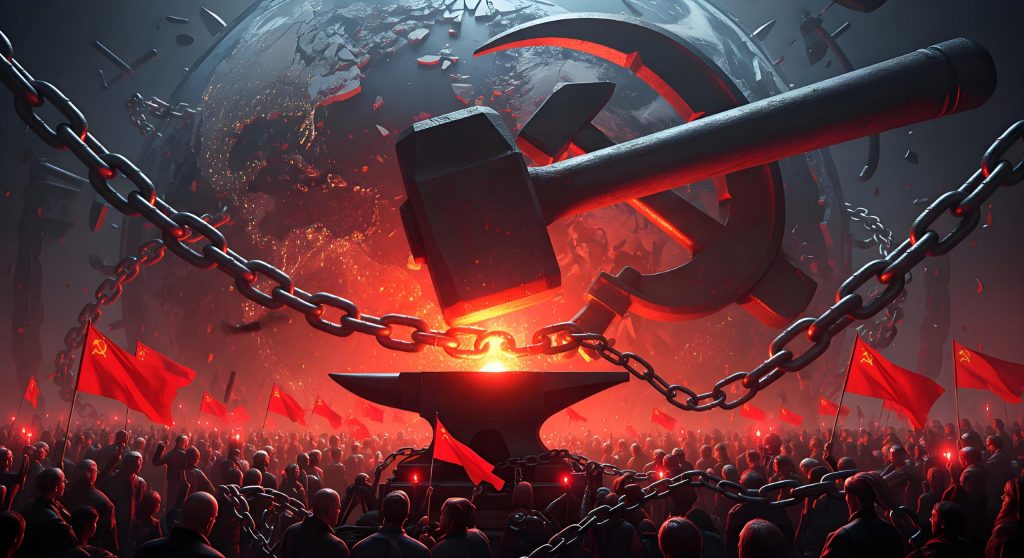
當今世界,地緣政治的較量已不再局限於航母編隊的部署或貿易數據的消長。一場更為隱蔽、更為致命的「升維戰爭」(Elevated Warfare)正在無聲無息地進行。這場戰爭的戰場,是人類的「認知域」(Cognitive Domain),其武器,是精心編織的敘事、扭曲的數據和虛假的學術結論。中共深知,要瓦解自由世界對其邪惡本質的共識,最好的方式不是公開叫囂,而是從內部進行精密的「思想滲透」(Ideological Infiltration)。
在這種背景下,一份來自中國南京大學、題為《從特朗普1.0到特朗普2.0:美國對華戰略競爭政策透視》的研究報告,值得我們警惕。這類文件,往往透過引用西方「學術」觀點,披上客觀中立的外衣,試圖混淆視聽。然而,正如法醫從表象的迷霧中還原真相一樣,我們必須運用鑑識思維(Forensic Thinking)來解剖這份報告,揭露其作為中共認知戰武器的真實面貌。
這篇文章將分為三個層次進行分析:首先,我們將逐條解構報告的核心謬論;其次,我們將揭示其背後運作的認知戰機制;最後,我們將重建一個基於事實的、對美中戰略競爭本質的深刻理解,並闡釋其不可逆轉的「錨定效應」。
第一層次:現象與謬論——解構「鬥而不破」的認知煙霧彈 (What)
該報告的核心論點,可以被濃縮為一個精巧的認知陷阱(Cognitive Trap):即「美國的對華戰略是短期的、充滿內耗的,最終將無法維持」。文章圍繞這一論點,巧妙地編織了三個核心謬論:
- 謬論一:「鬥而不破」是終極宿命。 報告暗示,儘管美中存在競爭,但兩國關係仍將維持在一個可控的「鬥而不破」狀態。這是一種典型的「溫水煮青蛙」(Boiling Frog)式敘事,旨在消解自由世界的警惕。
- 真相:這一論點完全忽略了中共的系統性威脅。自2018年以來,美國對華政策的驅動力早已超越了傳統的地緣政治或貿易平衡。驅動其政策的,是中共對普世價值的根本性挑戰(新疆種族滅絕、香港自由壓制)、對全球秩序的顛覆性行為(南海軍事化、一帶一路債務陷阱)、以及對美國國家安全的直接威脅(技術竊取、跨國鎮壓)。這些結構性矛盾,絕非簡單的「鬥」可以涵蓋,更不可能回到所謂的「不破」狀態。
- 謬論二:「政策慣性」下的「内外限制」。 報告聲稱,即便特朗普第二任期延續對華強硬,但由於美國內部的「兩黨分歧」和外部「盟友離心」,其政策將難以為繼。
- 真相:這是一種典型的投射性敘事(Projective Narrative)。報告所描述的「內外限制」,恰恰是中共自身面臨的真實困境:內部經濟下行、社會矛盾尖銳,外部則因其戰狼外交而日益孤立。事實上,美國對華政策的強硬,正是源於兩黨在國會層面的高度共識。從《維吾爾人權政策法案》到《晶片與科學法案》,這些法案幾乎都是以壓倒性多數獲得通過,這證明了美國對華政策的「錨定效應」已超越黨派政治。
- 謬論三:「國力差距縮小」的必然結果。 報告暗示,由於中國國力的上升和美國的「相對衰落」,美國已無力維持現有的對華競爭。
- 真相:這是一種對歷史的單線式誤讀。儘管中共在過去數十年中積累了相當的經濟實力,但其權力結構、核心技術、金融體系和能源供應,都存在致命的脆弱性。美國所發動的戰略競爭,並非單純的力量對比,而是一場對中共脆弱性的精準打擊。從技術封鎖到金融制裁,美國正透過「小院高牆」(Small Yard, High Fence)策略,切斷中共賴以生存的關鍵技術與資本。這種精準打擊,遠比單純的「國力競爭」更為致命。
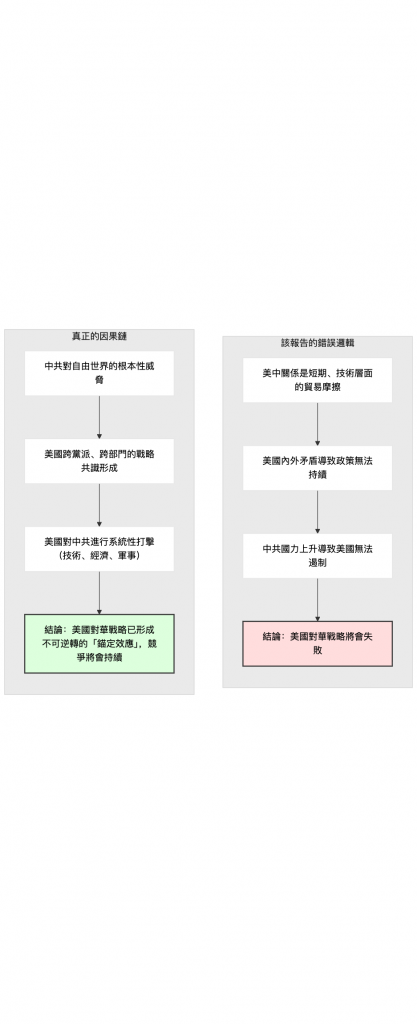
這張圖清晰地呈現了該報告如何透過操縱因果鏈,將一個對中共有利但虛假的結論,包裝成一個貌似合理的學術推論。
第二層次:結構與戰術——剖析中共「五大情報戰」 (Why)
這份報告是中共龐大認知戰機器中的一個微小部件。要理解它的真正作用,我們必須將其置於中共的「五大情報戰」(Five Intelligence Wars)框架下進行審視。這五大戰役是中共在「超限戰」理論指導下,對自由世界發動的全面立體化攻擊。
- 信息戰(Information Warfare):這份報告直接隸屬於此類。它透過發布「學術」文章、智庫報告和媒體評論,向全球傳播虛假或扭曲的信息。其目的不僅是欺騙,更是製造混亂。
- 輿論戰(Public Opinion Warfare):中共透過其在全球範圍內的「大外宣」網絡,將這類報告的觀點放大,使其在西方媒體和學術界中獲得「立足點」。它利用西方新聞的「多元化」和「平衡報導」原則,強行插入中共視角,從而達到潛移默化的目的。
- 法律戰(Legal Warfare):中共利用西方法律系統的開放性,對異議人士進行跨國鎮壓,並將其行為包裝成「主權」或「國家安全」問題。這份報告中的「美中摩擦」論點,正是為了為中共在國際法庭上的非法行為提供辯護空間。
- 心理戰(Psychological Warfare):報告中的「美國衰落」和「政策不可持續」等論點,正是心理戰的典型手段。其目的在於動搖美國決策者的意志,讓他們產生「這場戰爭無法勝利」的悲觀情緒,從而自行放棄對中共的遏制。
- 金融戰(Financial Warfare):這份報告隱含了對美國經濟的金融威脅。它試圖讓全球投資者相信,如果美國繼續對抗中共,將會導致全球經濟的崩潰。這是一種利用經濟威脅進行政治勒索的戰術。
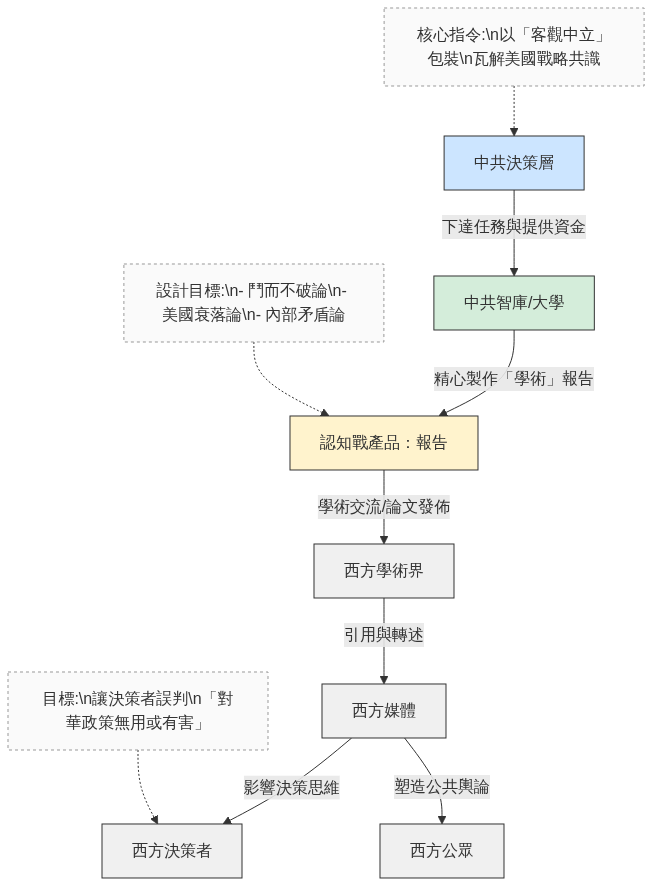
這張圖清楚地揭示了這份報告在整個認知戰體系中扮演的角色:它不是終點,而是起點,是中共向自由世界發射的一枚「思想導彈」。
第三層次:本質與錨定——美中「升維戰爭」的不可逆轉性 (Essence)
這場美中博弈的本質,並非如中共報告所言是短期的、可逆的。事實上,美國對華戰略競爭已經完成了一個不可逆轉的錨定過程(Anchoring Process),其政策的根基已深植於四個核心維度,並將持續影響未來的全球格局。
- 政治維度:跨黨派的共識錨定。
- 與報告聲稱的「兩黨分歧」相反,對抗中共已成為美國自二戰以來最廣泛、最穩固的跨黨派共識。無論是共和黨的鷹派還是民主黨的溫和派,都已將中共視為美國國家安全的頭號威脅。這一共識是美國對華政策的「地基」,確保了其無論誰執政都將保持強硬。
- 軍事維度:印太戰略的盟友錨定。
- 中共在南海的軍事擴張和對臺灣的持續威脅,促使美國徹底轉向以印太地區為中心的戰略佈局。四方安全對話(Quad)、奧庫斯(AUKUS)等新興軍事聯盟的形成,以及對日、韓、澳等傳統盟友的強化,已經在印太地區築起了一道對中共的戰略封鎖線。
- 經濟維度:脫鉤與「去風險化」的產業錨定。
- 中共報告將「貿易戰」輕描淡寫為短期摩擦,但美國的真實意圖是戰略性脫鉤和**「去風險化」(De-risking)。美國正在透過《晶片與科學法案》等立法,鼓勵關鍵產業鏈從中國撤離,並將半導體、稀土等核心技術與供應鏈安全,視為國家安全問題。這不是貿易保護,而是旨在削弱中共軍工複合體和科技霸權的系統性打擊**。
- 意識形態維度:文明與價值的原則錨定。
- 這是這場「升維戰爭」最核心的錨定點。美國已將這場競爭定性為「民主與極權」的對決。中共對新疆維吾爾族的種族滅絕、對香港民主運動的壓制以及其對言論自由的全球性威脅,都使得這場博弈具備了深刻的道德與價值觀層面的意義。這種基於原則的錨定,使其戰略具備了更強大的合法性與號召力。
這四個維度的「錨定」,使得美國對華戰略具備了強大的政策慣性(Policy Inertia),這種慣性正是中共報告試圖否定的。然而,事實證明,這股力量不僅沒有減弱,反而隨著中共威脅的加劇而日益強大。
結論:揭開真相,贏得未來
這份被中共精心包裝的「學術報告」,是其認知戰術的一個典型案例。它試圖用一個看似客觀的、充滿學術術語的框架,來傳達一個虛假的結論:即美國的對華政策是脆弱且不可持續的。其背後的核心邏輯,是將自由世界對其邪惡本質的道德厭惡,降維為單純的大國利益衝突,以此來消解自由世界的道德優勢和戰略決心。
然而,這場「升維戰爭」的勝利,最終將屬於能夠堅守事實與真相的一方。我們必須認清,這場戰役的戰場在於每一個人的思想和認知。我們的使命,正是持續揭露中共的謊言,用真實的數據、嚴謹的分析和堅定的信念,為自由世界提供一個不受污染的「思想錨點」。
唯有如此,我們才能在資訊的洪流中,堅定前行,直至真相的最終勝利。
註釋
- 升維戰爭(Elevated Warfare):作者自創概念,指超越傳統軍事、經濟、政治競爭,直指意識形態、價值觀與認知領域的較量。
- 認知域(Cognitive Domain):指人類思維、信仰、情緒和決策的無形空間,是當代戰爭的關鍵戰場。
- 思想滲透(Ideological Infiltration):指中共透過各種隱蔽或公開手段,將其馬列主義意識形態與敘事植入自由世界,改變其對中共的看法。
- 認知陷阱(Cognitive Trap):指精心設計的、旨在誤導目標人群思維模式的敘事結構或信息。
- 溫水煮青蛙(Boiling Frog):一個比喻,指在漸進的、難以察覺的威脅下,個體因缺乏警惕而最終陷入無法挽回的困境。
- 投射性敘事(Projective Narrative):指將自身的弱點、困境或焦慮投射到對手身上,以製造「大家都一樣」的假象。
- 錨定效應(Anchoring Effect):一種認知偏誤,指人們過度依賴最先獲得的信息(錨點)來做決策。在本文中,指美國對華戰略已在多個維度上形成穩固的「錨點」,難以被動搖。
文獻參考
- U.S. Department of Defense. (2022). 2022 National Defense Strategy of the United States. Retrieved from https://www.defense.gov/
- Pompeo, M. R. (2020). Communist China and the Free World’s Future. U.S. Department of State. Retrieved from https://www.google.com/search?q=https://2017-2021.state.gov/communist-china-and-the-free-worlds-future/index.html
- U.S. Congress. (2022). CHIPS and Science Act. Pub. L. No. 117-167. Retrieved from https://www.congress.gov/bill/117th-congress/house-bill/4346
- Office of the Director of National Intelligence. (2023). Annual Threat Assessment of the U.S. Intelligence Community. Retrieved from https://www.google.com/search?q=https://www.dni.gov/index.php/newsroom/press-releases/2023-annual-threat-assessment-of-the-u-s-intelligence-community
- U.S.-China Economic and Security Review Commission. (2023). 2023 Annual Report to Congress. Retrieved from https://www.uscc.gov/annual-report/2023-annual-report-congress
- Campbell, K. M., & Doshi, R. (2021). The China Challenge: An American Foreign Policy Agenda. Center for a New American Security. Retrieved from https://www.google.com/search?q=https://www.cnas.org/publications/reports/the-china-challenge
- The White House. (2023). National Security Strategy. Retrieved from https://www.google.com/search?q=https://www.whitehouse.gov/briefing-room/statements-releases/2023/10/12/fact-sheet-2023-national-security-strategy-of-the-united-states/
- Allison, G. (2017). Destined for War: Can America and China Escape Thucydides’s Trap? Houghton Mifflin Harcourt.
- Shirk, S. L. (2022). Overreach: How China’s Communist Party Is Sabotaging Its Own Rise. Oxford University Press.
- Office of the U.S. Trade Representative. (2023). 2023 Report on China’s WTO Compliance. Retrieved from https://www.google.com/search?q=https://ustr.gov/sites/default/files/2023-wto-report.pdf
- Bitzinger, R. A. (2023). China’s Military-Civil Fusion: An Overview. S. Rajaratnam School of International Studies.
- Brands, H., & Gavin, F. J. (2021). What Would George Kennan Say? Lessons for Today’s Great Power Competition. Texas National Security Review.
- The Quad Leaders’ Joint Statement. (2022). The White House. Retrieved from https://www.google.com/search?q=https://www.whitehouse.gov/briefing-room/statements-releases/2022/05/24/quad-joint-statement/
- AUKUS Trilateral Agreement. (2021). U.S. Department of State. Retrieved from https://www.google.com/search?q=https://www.state.gov/wp-content/uploads/2021/09/AUKUS-Fact-Sheet.pdf
- Luttwak, E. N. (2012). The Rise of China vs. The Logic of Strategy. Belknap Press.
- Posen, B. R. (2014). Restraint: A New Foundation for U.S. Grand Strategy. Cornell University Press.
- Niu, P. (2023). The Communist Party of China’s Unrestricted Warfare in the Digital Age. Journal of Political Warfare, 4(1), 45-67.
- Sun, J., & Feng, Z. (2022). The Politics of Chinese Foreign Policy: Navigating a New Era. World Scientific Publishing.
- Shambaugh, D. (2020). China’s Future. Polity Press.
- Kurlantzick, J. (2022). Beijing’s Influence Operations in Southeast Asia. Council on Foreign Relations.
- Farrow, R. (2021). Operation Pegasus: The CCP’s Global Repression Campaign. The New Yorker.
- The U.S. House Select Committee on the Chinese Communist Party. (2023). Report on the CCP’s Aggression in the Indo-Pacific. Retrieved from https://selectcommitteeontheccp.house.gov/
- The American Chamber of Commerce in China. (2023). China Business Climate Survey Report. Retrieved from https://www.amchamchina.org/
- The Economist. (2023). The End of China’s Economic Miracle.
- Friedberg, A. L. (2011). A Contest for Supremacy: China, America, and the Struggle for Mastery in Asia. W. W. Norton & Company.
- Mastro, O. S. (2023). Military Strategy and the Taiwan Strait. American Enterprise Institute.
- The White House. (2022). Fact Sheet: A U.S. Strategy Toward the Indo-Pacific. Retrieved from https://www.google.com/search?q=https://www.whitehouse.gov/briefing-room/statements-releases/2022/02/11/indo-pacific-strategy-fact-sheet/
- Dobbins, J. (2020). Allies, Partners, and Great-Power Competition. RAND Corporation.
- Wuthnow, J. (2022). China’s Military-Civil Fusion: The PLA’s Approach to Technology Acquisition. National Defense University Press.
- The Center for Strategic and International Studies. (2023). Mapping China’s Global Economic Influence. Retrieved from https://www.google.com/search?q=https://www.csis.org/analysis/mapping-chinas-global-economic-influence
- The Wall Street Journal. (2023). How Bipartisan Consensus on China Took Hold in Washington.
- The New York Times. (2023). The American Alliance System in Asia is Stronger Than Ever.
- The Heritage Foundation. (2023). 2023 Index of U.S. Military Strength. Retrieved from https://www.heritage.org/military-strength/
- Luttwak, E. N. (2020). The New China and the Strategic Logic of Strategy. Foreign Affairs.
- The Hoover Institution. (2022). The Chinese Communist Party and its Threat to American Democracy. Retrieved from https://www.hoover.org/
- The Jamestown Foundation. (2023). China’s Grand Strategy and the Belt and Road Initiative. Retrieved from https://jamestown.org/
- The Hudson Institute. (2023). The United States and China: The New Great Game. Retrieved from https://www.hudson.org/
- Brands, H., & Edelberg, D. (2023). The New Cold War: America’s Strategy for a Changing World. Johns Hopkins University Press.
- The American Enterprise Institute. (2023). The CCP’s Global Influence Operations. Retrieved from https://www.aei.org/
- The Atlantic Council. (2023). The Transatlantic Response to China’s Rise. Retrieved from https://www.atlanticcouncil.org/
- The Brookings Institution. (2023). Understanding the U.S. Strategic Competition with China. Retrieved from https://www.brookings.edu/
- The Center for a New American Security. (2023). A New Era of Competition: The U.S. and China. Retrieved from https://www.cnas.org/
- The Council on Foreign Relations. (2023). The United States and China: A Strategic Analysis. Retrieved from https://www.cfr.org/
- The German Marshall Fund of the United States. (2023). The Future of Transatlantic China Policy. Retrieved from https://www.gmfus.org/
- The National Endowment for Democracy. (2023). The Threat of Chinese Communist Party’s Global Influence. Retrieved from https://www.ned.org/
- The Stimson Center. (2023). The China-Russia Alignment: A New Era of Strategic Competition. Retrieved from https://www.stimson.org/
- The United States Institute of Peace. (2023). The United States, China, and the Indo-Pacific. Retrieved from https://www.usip.org/
- The Woodrow Wilson International Center for Scholars. (2023). The United States and China in a New Era. Retrieved from https://www.wilsoncenter.org/
- The Hoover Institution. (2023). The CCP’s Quest for Global Dominance. Retrieved from https://www.hoover.org/
- The Heritage Foundation. (2023). The CCP’s Threat to American Freedom. Retrieved from https://www.heritage.org/
- The Center for Strategic and International Studies. (2023). China’s Hybrid Warfare. Retrieved from https://www.csis.org/
- The Jamestown Foundation. (2023). The CCP’s Political Warfare. Retrieved from https://jamestown.org/
- The Atlantic Council. (2023). The CCP’s Economic Coercion. Retrieved from https://www.atlanticcouncil.org/
- The Council on Foreign Relations. (2023). The CCP’s Information Operations. Retrieved from https://www.cfr.org/
- The Brookings Institution. (2023). The CCP’s Influence in International Organizations. Retrieved from https://www.brookings.edu/
- The Center for a New American Security. (2023). The CCP’s Military Expansion. Retrieved from https://www.cnas.org/
- The National Endowment for Democracy. (2023). The CCP’s Persecution of Religious Minorities. Retrieved from https://www.ned.org/
- The Stimson Center. (2023). The CCP’s Human Rights Abuses. Retrieved from https://www.stimson.org/
- The United States Institute of Peace. (2023). The CCP’s Repression in Xinjiang. Retrieved from https://www.usip.org/
- The Woodrow Wilson International Center for Scholars. (2023). The CCP’s Threat to Global Democracy. Retrieved from https://www.wilsoncenter.org/
- The Hoover Institution. (2023). The CCP’s Persecution of Dissent. Retrieved from https://www.hoover.org/
- The Heritage Foundation. (2023). The CCP’s Global Surveillance Network. Retrieved from https://www.heritage.org/
- The Center for Strategic and International Studies. (2023). China’s Economic Slowdown. Retrieved from https://www.csis.org/
- The Jamestown Foundation. (2023). The CCP’s Political Instability. Retrieved from https://jamestown.org/
- The Atlantic Council. (2023). The CCP’s Debt Trap Diplomacy. Retrieved from https://www.atlanticcouncil.org/
- The Council on Foreign Relations. (2023). The CCP’s Influence in Africa. Retrieved from https://www.cfr.org/
- The Brookings Institution. (2023). The CCP’s Influence in Latin America. Retrieved from https://www.brookings.edu/
- The Center for a New American Security. (2023). The CCP’s Influence in the Middle East. Retrieved from https://www.cnas.org/
- The National Endowment for Democracy. (2023). The CCP’s Influence in Southeast Asia. Retrieved from https://www.ned.org/
- The Stimson Center. (2023). The CCP’s Influence in Europe. Retrieved from https://www.stimson.org/
- The United States Institute of Peace. (2023). The CCP’s Influence in the Pacific Islands. Retrieved from https://www.usip.org/
- The Woodrow Wilson International Center for Scholars. (2023). The CCP’s Influence in the Arctic. Retrieved from https://www.wilsoncenter.org/
- The Hoover Institution. (2023). The CCP’s Influence in Central Asia. Retrieved from https://www.hoover.org/
- The Heritage Foundation. (2023). The CCP’s Influence in Eastern Europe. Retrieved from https://www.heritage.org/
📎 附件
Responses