[Lude Press | Dr. Yan Talks] Trump’s Mockery: “He’s lost his mind—everything is under my control!” Starting from the chaos in French politics: What exactly are “Republic” and “Democracy”? 10/12/2025

Video link: https://www.youtube.com/live/6-6rqpV4FQM
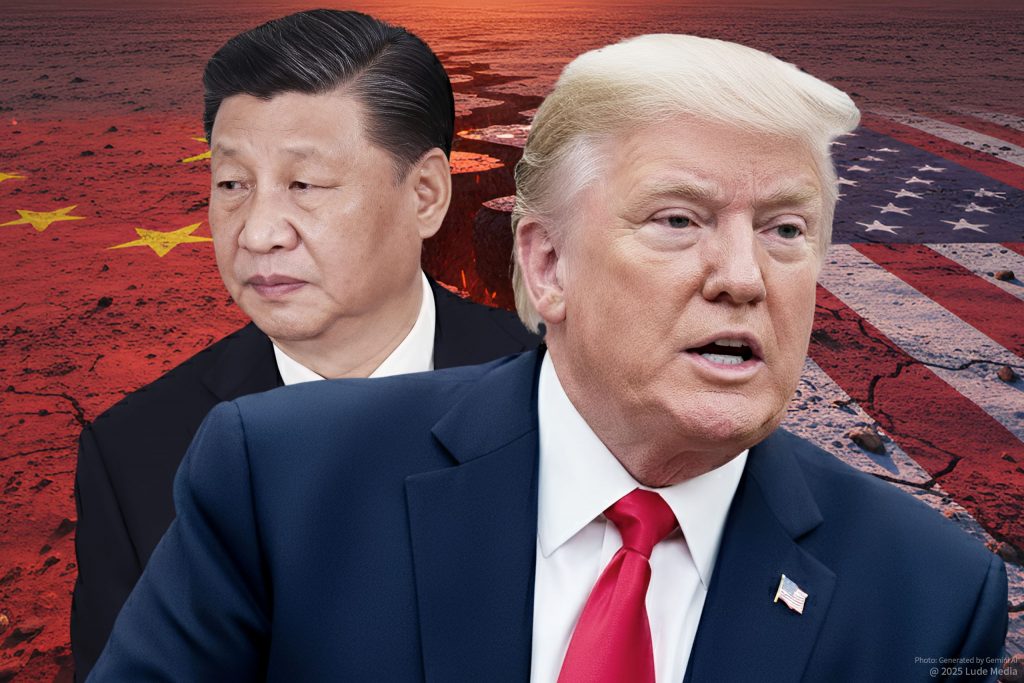
01|Xi Jinping Refuses to Take the Call? Trump Sneers: “He’s lost his mind—everything is under my control!”
◉ Reports from multiple sources revealed that Xi — representing the Chinese Communist Party — refused to answer calls from the United States. This came after China’s move to “weaponize rare earths,” essentially shutting down the door to dialogue with the U.S. on its own initiative.
◉ Today, Trump posted on “Truth Social” mocking Xi Jinping: (https://ludepress.com/featured/39865/)
▪︎ “President Xi just had a bad moment.” — This can mean Xi is simply in a bad mood, but it can also imply he’s mentally unwell, that he’s “having a breakdown.”
▪︎ “He doesn’t want Depression for his country.” — This isn’t praise suggesting Xi cares deeply about his nation; it’s a jab implying Xi has realized that his situation, and his regime, are in dire trouble.
Trump’s emphasis on the word “Depression” carries layered meaning. It not only refers to an “economic depression”, but also hints that everything is going wrong — the economy, politics, and the nation’s future — all bleak and hopeless. “Depression” can also mean “mental depression”, severe enough to cause self-harm or suicide. The implication: Xi is collapsing, to the point of self-destruction.
▪︎ “The U.S.A. wants to help China, not hurt it!!!” — Trump means: “We Americans want to help you, not harm you — but you’re the one hurting yourself.”
▪︎ “It will all be fine!” — Trump’s message: “Everything is under my control.”
This post from Trump is a textbook example of high-intensity “psychological warfare”.
02|Xi Jinping’s current state is a textbook case of the “terminal dictator’s dual defense mechanism” in political psychology.
Whether it is Xi himself who refuses to take the call, or his trade negotiation representatives under him who decline, doesn’t really matter. What’s important is that behind closed doors, Xi and the CCP act far less tough than they appear in public propaganda.
This so-called “weaponization of rare earths” is actually a symptom of mounting pressure and multiple setbacks that have driven Xi into a mental and emotional breakdown—manifesting as an outward display of hardline defiance. But this kind of defiant posture has also been seen before: Hamas, Iran, and Venezuela have all done the same. Yet behind the scenes, they never stopped lobbying the United States through back channels, trying to reopen a window for dialogue, essentially pleading for concessions. Their show of toughness is not about mutual destruction—it’s about raising their bargaining price. It’s all part of the same mindset and playbook.
Trump sees this clearly. To him, Xi simply misplayed his hand—thinking that “weaponizing rare earths” would be a powerful bargaining chip. He kept escalating, only to realize it was a miscalculation that backfired completely, and Trump caught him right in the act.
How can the U.S. recognize this pattern so easily? Because over a century ago, American academia had already been studying such terms, theories, and case studies across multiple disciplines.
Acting tough and confrontational on the surface while stalling and pleading in private has a formal term in political psychology: the terminal dictator’s dual defense mechanism. It’s a phenomenon, not an isolated case. The outward expression is “omnipotence delusion”; the inner core is a hidden “instinct for survival”.
In psychological terms, Xi is now showing cognitive dissonance–based hardline behavior—that is, when a person realizes that reality threatens their long-held beliefs (for example, believing “I am invincible”) and suddenly discovers “things aren’t like that,” they respond by reinforcing that belief even more intensely to ease their anxiety.
All the current “wolf warrior” posturing of the CCP fits a specific concept in strategy: false escalation before an ultimatum. This is a classic model in game theory and diplomatic strategy—an “escalation before collapse.” It describes how a weaker party, unable to withstand pressure, will create a last-minute crisis to make the opponent fear that further escalation will be too costly, thereby buying a brief moment to breathe. Within an authoritarian strategic framework, such behavior becomes even more irrational.
In strategic theory, such a situation can be understood in two ways:
- The advantage is yours—you control the situation, and your opponent has been driven to desperation. As Trump put it: “Don’t worry about China, it will all be fine!”
- The weaker side (Xi’s CCP gang) engages in this “pre-collapse escalation” precisely because they know they cannot win, and they are merely trying to save face and preserve the illusion of control.
Now, Xi’s CCP gang have fallen into an endless loop of public toughness and private pleading. This is called the dominance-anxiety cycle—the weaker side fears losing control, so it manufactures confrontations to prove that it still commands the situation, even though these very confrontations keep repeating and ultimately accelerate its own collapse.
03|The Chaos in French Politics: Constantly Changing Prime Ministers, Failed Budgets, and a Deeply Divided Parliament
France’s political scene is in turmoil. During Macron’s current term alone, he has already replaced five or six prime ministers. The latest one, Sébastien Lecornu, resigned just 27 days after taking office. Within 48 hours, Macron asked for a new appointment—and unexpectedly reappointed Lecornu as prime minister again.
Macron’s government has been stuck in a political deadlock for months. The main issue is that for several consecutive terms, his administration has been unable to pass deficit-cutting bills through parliament. Many lawmakers have lost confidence in Macron.
The problem in France today is not “who” becomes prime minister, but that “no matter who” takes the job, they are trapped within the system itself. France is currently under its Fifth Republic—each “Republic” represents a new constitution. The current one is a semi-presidential system. In this system, Macron, as president, does not command a majority. Neither the left nor the right in parliament will cooperate with him; both sides are opposition. So, unless he dissolves the National Assembly or resigns early, his only option is to keep replacing prime ministers, hoping to find one who can satisfy enough factions to turn his minority into a working majority and push his policies forward. The role of prime minister has become a scapegoat position. Lecornu is essentially a “firefighter”—there simply isn’t anyone better suited or willing to take the job.
For the French government, the most pressing issue is that if it fails to submit a fiscal budget by this Wednesday, the administration will automatically fall into an unconstitutional and suspended state. France’s fiscal deficit now stands at 5.5% of GDP, and national debt has surpassed €5.2 trillion. The Ministry of Finance is basically sitting on a volcano.
At its core, the problem is simple: France earns too little and spends too much. It’s a typical high-welfare state—the quality of life is high, but economic growth is no longer sufficient to support its massive expenditures. The government must borrow money every year to keep the welfare system running, and the debt keeps snowballing. That’s why the new fiscal budget is bound to be stalled—no one dares to cut welfare, and no one dares to raise taxes. Meanwhile, the European Union, along with international credit rating agencies such as Moody’s and S&P, are closely watching France’s finances. If fiscal tightening fails, France’s credit rating will be downgraded, leading to a surge in bond interest rates. Hence, the deadlock. Parliament is extremely fragmented. Macron calls himself a centrist, but in doing so, he pleases neither side—both the left and the right are dissatisfied.
At this point, Macron is merely trying to finish his term. Political parties no longer bother supporting him; they’re already preparing for the next presidential election. Macron refuses to step down early for two reasons: first, he doesn’t want to sign his own political death warrant—he wants to preserve his reputation and legacy; second, if he resigns now, there is no clear successor, and France’s political scene would descend into chaos, with left, center, and right factions all scrambling for power.
04|France’s “Fifth Republic,” Established in 1958, Has Essentially Reached Its End and Needs an Overhaul
What France is experiencing now is not just a political malfunction—it’s a systemic paralysis. The Fifth Republic has entered a stage of constitutional exhaustion, moving toward a state of “legal collapse”. The checks and balances between the president, parliament, and government have broken down completely. Even Macron himself has become a president without legitimate governing authority.
The semi-presidential system of the Fifth Republic was designed by Charles de Gaulle. Its foundation assumed that the president would have both political prestige and a stable majority backing him. Previously, France’s political scene was dominated by two blocs—left and right. But now, the far-left and far-right have both risen, fragmenting the landscape. The president no longer has the authority or moral weight to uphold the system. What was once a strong-president, weak-parliament model has now devolved into a decentralized struggle among left, center, and right factions.
France is now effectively sliding into a state of anarchy. This means that the Fifth Republic, born in 1958, has basically reached its end. The country now faces an unavoidable task: a structural upgrade and renewal of the republic itself.
05|What Exactly Are “Republic” and “Democracy”?
The Chinese understanding of “republic (共和)” has always been inadequate. The translation of the English word “republic” never captured its essence. After the CCP came to power, it perpetuated this mistranslation, creating the so-called “People’s Republic of China” and redefining the word to fit its own ideological narrative. The same happened with “democracy” (民主): both concepts were linguistically reshaped to serve propaganda, gradually hollowed out of their original meaning.
◉ What Is a “Republic”?
To understand “republic”, one must begin with “The Federalist Papers”, the foundational collection of essays that shaped the creation of the United States Constitution. Several key essays—authored by Alexander Hamilton, James Madison, and John Jay—discussed the principles of “republic” and “faction.” Madison, often called the “Father of the Constitution” and later the fourth U.S. president, played a crucial role in designing the system of “checks and balances” among the three branches of government.
When we speak of “republic,” Madison’s writings are indispensable. In “Federalist No. 10” and related essays, he argued that a “large republic” could best dilute the dangers of factionalism, and he introduced his famous maxim: “Ambition must be made to counteract ambition.” That principle lies at the heart of the American constitutional system.
Madison defined a “faction” not as a political party, but as a group of citizens united by a shared passion or interest. Factions are not necessarily good, they can also be bad, as they can harm the overall interests of society or the rights of other citizens. Because of differences in human nature and wealth, such as conflicts of interest between the propertied and the proletariat, and between different industries, factions cannot be completely eliminated; they can only be controlled through institutional mechanisms. Hence, thinkers like Marx, Lenin, and Mao, who dreamed of “eliminating all property-owning classes so that only the proletariat remains,” were promoting a utopia; factions can never be eliminated.
In Madison’s view, “small republics” were dangerous because their limited scale made it easy for factions to form and coordinate. In a small setting, a minority could easily dominate government, resulting in “mob rule” (if violent) or “the tyranny of the majority” (if political). Either way, it undermines a stable, deliberative constitutional system. By contrast, a “large republic” could spread power across a broader population, dilute factional influence, and foster more diverse interests and opinions that must negotiate with one another.
A “republic”, moreover, must be “representative”. It is not pure democracy, but a system like that of U.S. congressmen and senators—representatives chosen for their wisdom and merit, not their populist fervor. A broad electorate choosing representatives across the nation better preserves balance and filters out local biases, preventing regional factions from hijacking policy.
Madison noted that no single faction could ever dominate all the states—then thirteen, now fifty. Even if radical movements arose locally, they could not easily engulf the whole nation. To institutionalize this safeguard, the “federal system” was designed, distributing power between the central and state governments.
Thus, “republican government” represents a structured form of democracy—a framework of governance by elected representatives acting within constitutional constraints to prevent both tyranny and factional capture.
Madison traced “republic” back to the Latin “res publica”, literally “public affairs” or “public thing,” emphasizing governance of shared affairs under the rule of law, being moderated by representative institutions and constrained by constitutional limits on power.
Once this is understood, it becomes clear that the “People’s Republic of China” is “republican in name only”.
① There is no genuine constitution;
② There are no true representatives;
③ There are no limits on power.
Thus, the CCP’s use of the term “republic” is entirely a facade.
Furthermore, the essence of “republic” lies in rule of law, not merely majority will. The Roman Republic is a classic example—it had a Senate, magistrates, codified law, and institutionalized separation of powers. That, fundamentally, is what “republic” means.
◉ What Is “Democracy”?
The word “democracy” comes from Greek roots—”demos” (people) and “kratos” (rule)—literally meaning “rule by the people” or “rule by the majority.”
In classical Greece, democracy referred to direct democracy, exemplified by the “Athenian Assembly”, where every citizen had a vote—one person, one vote. It’s like the United Nations today: every member state, large or small, gets a single vote. This is called “direct democracy”. The greatest danger of direct democracy is the tyranny of the majority—It’s easy to form a majority; if you have the majority, you directly possess power(often trampling minority rights). This built-in flaw has long been recognized in political philosophy. It is fundamentally different from how Chinese people use the term “democracy(民主).” (Which has been simplified to mean “everyone votes, and that’s fair.”)
In China, political education never explains that “republic” actually implies “rule of law”, nor that it signifies governance under a constitution through representation and legal constraint.
The CCP is currently promoting a “tyranny of the majority” model within one-sided democracy(a pseudo-democratic system in which majority rule serves as a cover for one-party domination). No matter where, the CCP is exporting this model of rule. For instance, in Belt and Road countries, once the CCP controls drug lords or pro-Beijing groups(local elites), any “democratic vote” conveniently produces the results they want. It’s a simple mechanism: the CCP exploits local democratic systems to impose majority tyranny that benefits itself.
The CCP also never tells its citizens that the word “democracy” carries its own internal contradictions. Instead, it relentlessly brainwashes the public with propaganda: “You still want democracy? Look at those chaotic democratic countries—government shutdowns, endless brawls, drugs, murders, conspiracies.” Hence, the logic goes, Chinese people shouldn’t want democracy at all; they should obediently live within the Party’s fenced pen as “the people” under the so-called “People’s Democratic Dictatorship”. Waiting to be slaughtered like pigs or leeks. This phrase, of course, is an absurd mashup—”People’s Republic” and “People’s Democracy” have nothing to do with their original meanings.
◉ How Western Political Terms Were Lost in Translation
When Western political vocabulary entered China over a century ago, translators imposed their own preferences, ideologies, and different political fields. The resulting terms rarely matched the original meanings.
For example, “colonial” originally referred to settlement and the expansion of civilization. But the CCP twisted the Chinese term “殖民(colonial)” by emphasizing the character “殖(enslavement)”—which in modern Chinese means “to breed” or “to reproduce” [Translator’s note: In Chinese dictionaries, “colonial” means invasion(侵略), enslavement(奴役), and plunder(掠夺), refers to an unequal relationship of rule.]—evoking images of domination and exploitation. Likewise, “republic” and “democracy” lost their nuance through inconsistent or politically motivated translations.
In the West, political and legal education delves deeply into etymology—the roots and evolution of such words, much like studying a family tree. Understanding how “republic” evolved through history reveals both its meaning and its limits, helping lawmakers choose terms with precise legal implications. But in China, the evolution of language and law became like water without a source(no origin, no evolution, no development, no progress).
Even worse, many terms first introduced during the late Qing and Republican eras were later censored and redefined under Communist rule to align with Party ideology. This reflects a broader “culture of castration” in which inconvenient ideas are systematically neutered, this is a vicious cycle of China’s closed culture.
In English, terms are “alive”—they grow and adapt through discourse and usage. But once translated into Chinese under the CCP, they became dead words—frozen, stripped of nuance. For over a century, the meanings of words have neither been enriched nor put into practice. And after being politically censored and reinterpreted by the CCP, these messages are incorporated into propaganda to brainwash others.
When Chinese people hear “republic,” they think of “Guardians of the Republic” or “Republic Medals.” They immediately equate it with the “People’s Republic”, without ever pausing to ask what “republic” itself actually means, or why a political system would call itself one.
As for “democracy,” most Chinese equate it with simple voting—”everyone votes, that’s democracy”. They then contrast it with American democracy, which they’re told is chaotic, and conclude that “people’s democratic dictatorship” must be better. In this way, the CCP has erased the true philosophical roots of “constitutional republicanism” and stripped “democracy” of its built-in warning about majority tyranny—leaving behind only an empty, brainwashing narrative:”Democracy is messy. We are orderly. Therefore, we are better.” A word can have both positive and negative interpretations, but the CCP removes the positive and amplifies the negative.

Responses